Operation Lightfoot: Bolton’s Gunners at El Alamein
On the night of 23 October 1942, the desert at El Alamein erupted in gunfire. Among the men taking part were the soldiers of the 111th (Bolton) Field Regiment, Royal Artillery. Their October war diary, alongside the personal recollections of Sergeant Frederick Sidney Williams of 212 Battery, tells a story of exhausting preparations, infantry attacks, sudden casualties and an officer who returned after being taken prisoner.
Williams captured the opening night in a few words:
“My God! What a night, as if all hell had been let loose.”
For Bolton’s gunners, one of the most famous battles of the war had become an immediate struggle to keep the guns firing and support the men fighting ahead of them.
Preparing for the attack
By October, the opposing armies faced one another across a defensive belt between the Mediterranean and the Qattara Depression. Extensive minefields and fortified positions barred the Eighth Army’s advance.
Lieutenant-General Bernard Montgomery’s plan called for infantry to penetrate the defences and engineers to clear routes through the minefields, allowing armour to follow. The main assault would fall in the north, while attacks farther south would help occupy the enemy and prevent reserves being freely moved against it.
The 111th was supporting the 50th (Northumbrian) Infantry Division south of Ruweisat Ridge. This placed the regiment away from the principal northern assault, but its guns and forward observers still had demanding work ahead.
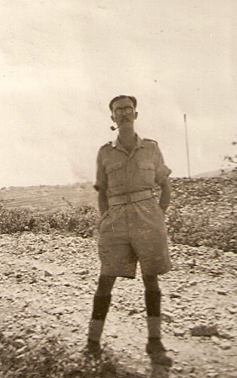
Williams’s account reveals the physical effort behind those preparations. Gun positions and command posts had to be dug into difficult ground, sometimes while blowing sand undid the men’s work. One command post was reinforced with sandbags and covered using a truck frame.
Later, the men worked through the night on another position, only to discover in daylight that it was too exposed. They had to move and dig again.
The proximity of the infantry brought home how far forward they were. Williams described Green Howards occupying a ridge barely twenty yards ahead of the guns. Orders to remain silent meant the batteries had to prepare and wait without revealing themselves through firing.
The night the guns opened up
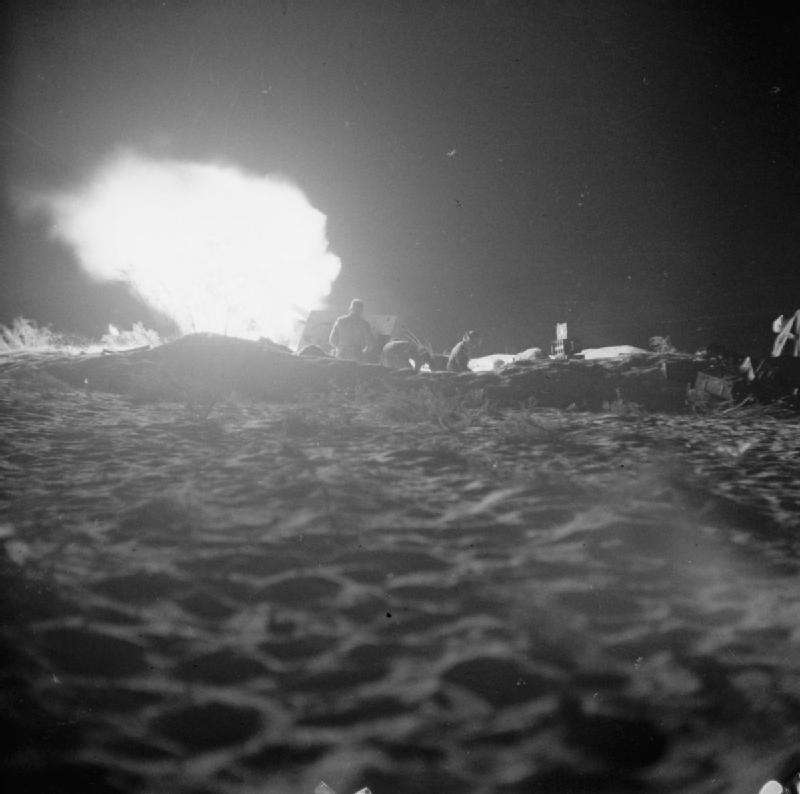
At 9.40 p.m. on 23 October, the opening artillery bombardment began. Across the battlefield, hundreds of guns struck the enemy’s positions before the infantry advance.
For Williams, the transformation from a quiet day to a horizon filled with gun flashes was overwhelming. Unable to sleep, he watched from a small rise behind the command post.
Yet his recollections quickly move beyond the spectacle. His thoughts were with the infantry advancing into the darkness, and before long there was urgent work to do. During the early hours, a request arrived for smoke to assist infantry in difficulty. Williams and Partington hurried to handle it.
This was the practical purpose of the artillery battle: to put fire or smoke where the troops needed it, often with little time to spare.
The danger extended to the observers working forward. Williams recalled an observation post’s wireless falling silent and subsequently learning that it had been struck by mortar fire. The men who directed the guns shared the risks faced by the infantry they supported.
Captain Mellor: missing, captured—and back again
The morning of 24 October brought troubling news.
At 8.10 a.m., the regimental diary recorded 212 Battery’s casualty report: three men killed, one wounded and evacuated, and two with superficial wounds. Captain K. W. Mellor was believed wounded and missing.
For several hours, his fate remained uncertain. Then, at 1 p.m., the diary recorded that Mellor was safe. He had been taken prisoner by Italian troops and had escaped.
Two brief entries preserve a remarkable reversal: an officer feared lost in the opening battle was back within hours.
Williams’s personal account adds a striking detail. He remembered an officer, whose surname he wrote as “Miller”, escaping in the back of a Sherman tank. The website’s biography of Keith Wilson Mellor connects that recollection with Mellor’s capture. The contemporary diary firmly establishes the capture and escape; the Sherman detail comes from Williams’s account.
Even with that distinction, the episode gives a vivid glimpse of the confusion of the fighting. Men could become separated, fall into enemy hands and make their way back while the batteries continued their work around them.
Supporting the infantry
The regiment remained busy throughout 24 October. During the afternoon, it fired 432 rounds at a reported concentration of approximately 300 vehicles and tanks in the Alinda Depression. The diary could not confirm the results because they were not visible from the observation post.
That qualification matters. The record shows what the regiment fired at, without claiming destruction its observers could not verify.
Elsewhere, 476 Battery came under mortar fire. That evening, the 111th and 124th Field Regiments delivered a programme of concentrations lasting eighty minutes.
On 25 October, another bombing attack killed a man in 212 Battery. That night, the guns supported the 6th Green Howards attacking Points 92 and 94 and the East Yorkshire Regiment attacking Point 101. Smoke covered the infantry’s forming-up area, while forward observation officers from 212 and 476 Batteries accompanied the troops.
The diary’s timed entries show how quickly the situation changed. At 12.42 a.m. on 26 October, Point 94 was reported taken, but the East Yorkshires had been held up. Thirteen minutes later, artillery fire was ordered onto Point 101 to help them withdraw.
The Green Howards also encountered strong resistance. Further concentrations followed, and another attack on Point 92 was supported during the afternoon.
These entries show artillery supporting each stage of an infantry action: covering preparations, firing on objectives, responding to resistance and helping troops disengage when necessary.
The fighting continued
On 27 October, the regiment received orders to move. Regimental headquarters, 211 Battery and 212 Battery relocated to support the 1st Free French Brigade, while 476 Battery remained under the 124th Field Regiment’s group.
The move brought no immediate respite. On 28 October, shelling killed another man in 212 Battery, and regimental headquarters also came under fire. The remaining days of the month included further engagements and harassing fire.
Williams remembered serving alongside Greek and Free French troops in this later position. His account describes vehicles being driven about to give an impression of greater strength—another small detail of a battle fought through concealment and deception as well as firepower.
Lightfoot had opened the offensive, but it had not produced an immediate breakthrough. The wider battle developed into sustained fighting as the Eighth Army wore down the Axis defences. Operation Supercharge followed in early November, and by 4 November the Axis position had broken and the retreat was underway.
For the 111th, those events were experienced through individual fire orders, exposed observation posts, hurried moves and the loss of comrades. Their October record preserves Bolton’s part in the battle at that human scale.